Reproduced here exactly as published in the edition: the full account of how this Bible was made — every source, every category of treatment, every use of AI, and everything we refused to do.
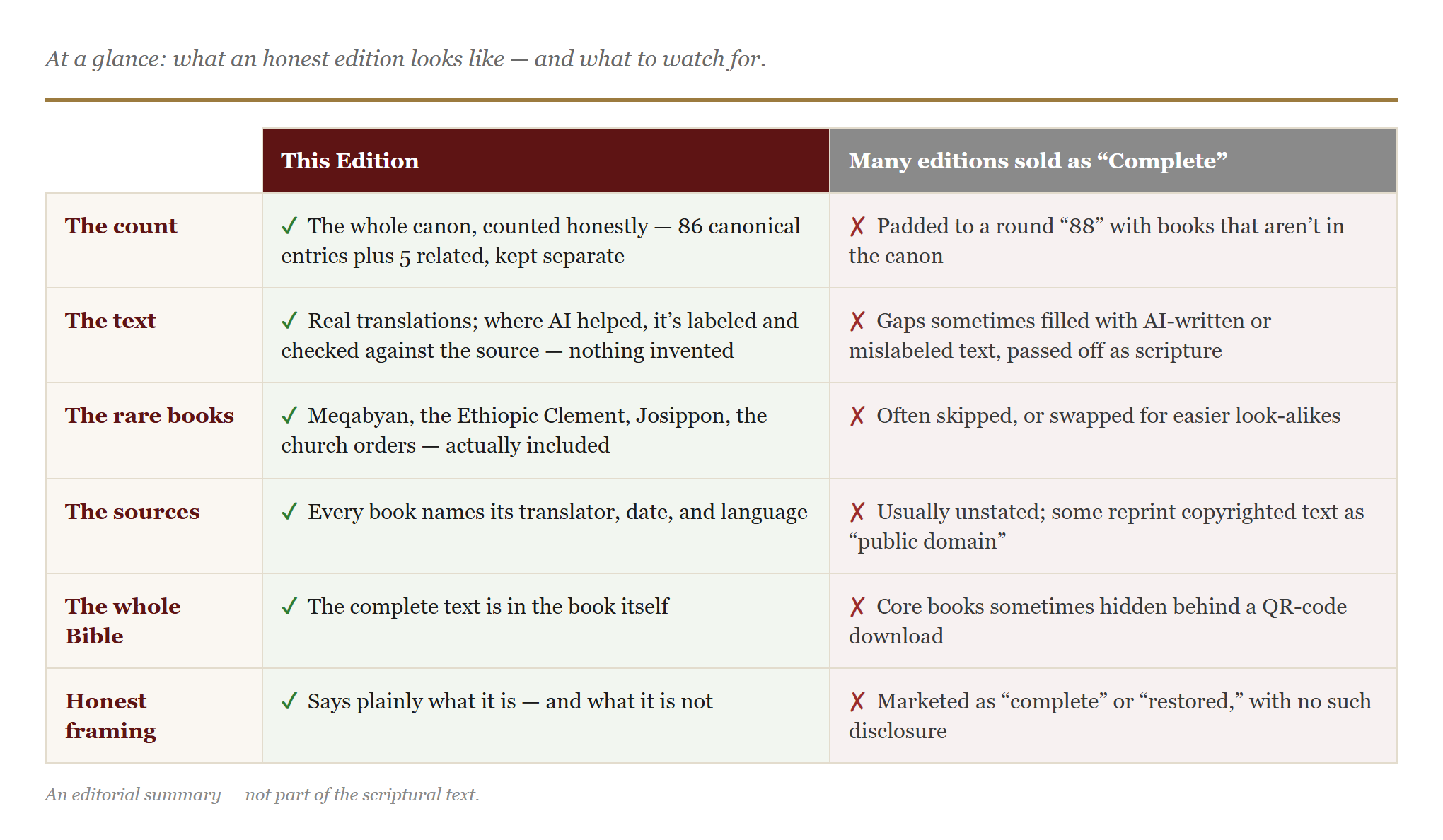
Methodology & Source Disclosure
This appendix documents every source used in this edition, the treatment applied to each text, and our approach to AI-assisted translation. We believe full transparency about our methods is essential to the integrity of this work.
Source Classification
Every book in this edition falls into one of two categories. Earlier drafts of this edition contemplated a third category — light AI modernization of Victorian-era public domain translations — but that approach was abandoned. If a reader can navigate the American Standard Version (1901) for the Old and New Testaments, that same reader can navigate Horner’s or Harden’s Victorian scholarly prose in the church-order books. Maintaining parallel modernized and reference versions also proved impractical for print page-count reasons, and AI modernization introduced subtle meaning drift we were unwilling to accept.
Category A — Direct Public Domain Translations
Approximately 83 books are drawn directly from existing English translations published before 1929 and confirmed to be in the public domain under United States copyright law. These texts required only cleanup operations: stripping scholarly apparatus (footnotes, critical apparatus blocks, parallel source-language columns, page headers and footers, translator’s introductions and indexes), correcting OCR artifacts from digitized sources (broken ligatures, misread characters, rejoined line-break hyphens), and normalizing chapter/verse notation. No words were added, removed, modernized, or altered in meaning. The translator’s original English prose is preserved verbatim.
Primary sources in this category:
| Source | Date | Translator | Books Covered |
|---|---|---|---|
| American Standard Version | 1901 | American Revision Committee | Standard OT & NT (39 + 27 books) |
| Brenton’s English Septuagint | 1851 | Sir Lancelot C.L. Brenton | Deuterocanonical books: Tobit, Judith, Wisdom of Solomon, Sirach, Baruch, 1-3 Maccabees (Greek), Psalm 151, additions to Esther |
| KJV Apocrypha | 1611 | Authorized Version translators | 2 Esdras |
| The Ascension of Isaiah (SPCK, Translations of Early Documents) | 1917 | R.H. Charles | Ascension of Isaiah (11 chapters) |
| The Uncanonical Writings of the Old Testament (Venice) | 1901 | J. Issaverdens | 4 Baruch / Paraleipomena Jeremiou (from the Armenian; see caveat at that book) |
| Joseph and Asenath (SPCK, Translations of Early Documents) | 1918 | E.W. Brooks | Joseph and Aseneth (29 chapters; from the Greek) |
| The Book of Enoch (SPCK, Translations of Early Documents) | 1917 | R.H. Charles | 1 Enoch (108 chapters) |
| The Book of Jubilees (SPCK, Translations of Early Documents) | 1917 | R.H. Charles | Jubilees (50 chapters) |
| The Statutes of the Apostles | 1904 | Rev. G. Horner | Sinodos: Ser’atä Seyon, Te’ezaz, Abtelis |
| The Apostolic Canons | 1885 | George H. Schodde | Sinodos: Gessew |
| The Ethiopic Didascalia | 1920 | J.M. Harden | Ethiopic Didascalia |
| The Testament of Our Lord | 1902 | James Cooper & A.J. Maclean | Books of the Covenant I & II (translated from Syriac Testamentum Domini; see caveat at those books) |
Every text in this category is traceable to the Sources Registry
(sources.yaml) with translator, publication year, and
digitization URL.
Category B — AI-Assisted Translation
A small number of books had no prior complete English translation in the public domain. For these, we employed AI-assisted translation from the best available public domain source in another language. These books are clearly identified throughout the text with the notation [AI-Assisted Translation] at the head of each book and chapter.
Books in this category:
| Book | Source Language | Source Text | Method |
|---|---|---|---|
| The Books of Meqabyan (I-III) | German (from the Ge’ez) | Josef Horovitz, “Das äthiopische Maccabäerbuch,” Zeitschrift für Assyriologie XIX (1905), from the Frankfurter Codex Rüppell II 7 | German→English AI translation (two removes from the Ge’ez) |
| Ethiopic Clement (partial; serialization terminated mid-Part 3 — see Methodology) | French | Sylvain Grébaut, Revue de l’Orient Chrétien vols. 16-19 (1911-1914) | French→English AI translation |
| Josippon | Hebrew (proxy) | Günzburg–Kahana Sefer Yosippon, Mantua short recension (Berditchev, 1896–1913) | Hebrew→English AI translation — provisional |
AI Translation Pipeline
For Category B texts, we used a two-stage pipeline designed to maximize accuracy and minimize hallucination:
Stage 1 — Primary Translation (OpenAI GPT-5)
The source text was divided into chunks of 600-1,200 words,
preserving chapter and verse boundaries. Each chunk was submitted to
GPT-5 with the following constraints: - Translate literally, preserving
the source text’s structure and meaning - Do not add interpretive
material, commentary, or explanatory notes - Preserve all proper nouns
in their established transliterated forms - Flag any passage where the
source text is ambiguous or damaged with an explicit
[unclear: ...] or [translator's note: ...]
marker - Maintain consistent terminology across chunks
Stage 2 — Accuracy Review (Anthropic Claude)
Each translated chunk was submitted to Claude with the original source text for back-reference. Claude evaluated each chunk on five criteria (accuracy, completeness, register, fluency, consistency) on a 1-5 scale, and flagged: - Omissions (content present in source but missing from translation) - Additions (content in translation not present in source) - Critical errors (meaning-changing problems) - Theological terminology inconsistencies
Stage 3 — Re-translation of Low-Scoring Chunks
Any chunk scoring below 4.0 was re-translated with reviewer feedback incorporated into the prompt.
Stage 4 — Assembly & Integrity Check
Translated chunks were reassembled into complete books. An automated check verified that all chapter and verse numbers were present and sequential. A final human review pass checked for consistency of style and terminology across chapter boundaries.
Specific Notes on Difficult Texts
The Books of Meqabyan (1-3)
The three Books of Meqabyan are indigenous Ethiopian compositions that exist only in Ge’ez and (in later derivative manuscripts) Amharic. Despite their name (sometimes rendered “Ethiopian Maccabees”), they bear no literary relationship to the Greek Books of Maccabees. They concern themes of martyrdom, faithfulness to God, and divine justice — and are transmitted in the Ethiopian manuscript tradition as one work in three sections rather than as three discrete books. We have followed the manuscript tradition’s structure rather than the canonical convention of counting three separate books: the text appears in this edition as a single combined entry. The conventions by which the Ethiopian canon is counted — and where this edition’s total of 86 canonical entries sits among them — are set out in A Note on Canon Counting below.
An earlier draft of this methodology described our source as the Amharic manuscript tradition, supplemented by Ras Feqade Selassie’s online Iyaric (Rastafari liturgical English) rendering as a cross-reference. That description was inaccurate. After diligent search no clearly public-domain Amharic source could be located; the Iyaric rendering is a loose liturgical paraphrase rather than a literal translation and is not usable as a primary source; and Feqade Selassie’s separate “Standard English” Meqabyan (published via Lulu.com) is copyrighted and was not used. The source we settled on is Josef Horovitz’s 1905 German rendering: “Das äthiopische Maccabäerbuch,” in the Zeitschrift für Assyriologie und verwandte Gebiete, Band XIX (1905/1906), pp. 194–233. Horovitz worked from the Frankfurter Codex Rüppell II 7, an 18th-century Ge’ez witness — not from Amharic. The translation chain into English for this book is therefore Ge’ez → Horovitz’s 1905 German → AI English, two removes from the original language.
Horovitz’s German rendering is itself heterogeneous in fidelity. Approximately half the article is close translation of specific manuscript folios, anchored by inline folio markers we preserve in the English. The remainder is a mixture of content summary (where Horovitz paraphrases stretches of the codex rather than translating them) and paired Ge’ez-extract-plus-German-rendering blocks where Horovitz transcribed the original and supplied his own German alongside. The English translation faithfully reflects this heterogeneity rather than smoothing it into uniform narrative prose. The accuracy review pass from our AI pipeline tracked the prediction that passages shifting between Horovitz’s three modes within a short span would be the hardest to translate consistently, and the small number of editorial fixes applied during assembly are concentrated in those passages; readers who encounter a stylistically uneven passage should be aware that the unevenness traces back to Horovitz’s mode shifts and is preserved deliberately. Manuscript page markers and Horovitz’s editorial inserts are preserved. His prefatory material — German introduction and translation-strategy notes — is excluded from our English text on the same principle that excludes Grébaut’s prefaces from our Ethiopic Clement: it is scholarly apparatus framing the translation, not translation of the text itself.
One convention is preserved untranslated. Horovitz divides the corpus into three sections, each labeled “Abschnitt” in his German. We carry this label through in English rather than translating it as “Section” or “Part.” The motivation is fidelity to Horovitz’s structural framing — readers consulting our English alongside Horovitz’s German will see the same section labels — and recognition that the underlying Ge’ez tradition does not assign canonical section labels of its own. The closing colophon of the third section, which Horovitz renders with the German word, is preserved with the German word.
Readers comparing this text against the Book of Josippon, also in this edition, should know that Horovitz observed the Meqabyan author drawing on the Sefer Yosippon tradition for certain narrative material. The two AI-translated texts therefore share genuine narrative content, and an unfamiliar name or phrasing in one of them may originate in the other. They were translated independently from their respective source languages, German for Meqabyan and Hebrew for Josippon, and their terminology has not been artificially harmonized; cross-reference at the level of underlying content has been left to the reader.
Readers should treat this translation as a working rendering, not a definitive critical translation. The Ethiopian Orthodox Bible Project’s direct-from-Ge’ez translation work, when published, will supersede ours.
Ethiopic Clement (Qälëmentos)
The Ethiopic Book of Clement is a unique text in seven parts, unrelated to the Epistles of Clement found in other Christian traditions. It presents visions communicated by the Apostle Peter to Clement of Rome. The only public domain rendering is Sylvain Grébaut’s French translation, published serially in the Revue de l’Orient Chrétien between 1911 and 1914.
Our English text was produced by AI translation from Grébaut’s French. This introduces a known limitation: our text is an English translation of a French translation of a Ge’ez original — two removes from the source language. We have noted this throughout the text.
Grébaut’s serialization is itself incomplete. Its
final installment — Revue de l’Orient Chrétien vol. 19 (1914),
pp. 324-330 — opens Part 3 at “Chapitre Premier” and breaks off on
p. 330 at the close of a passage on priestly ordination irregularities
(which Grébaut footnotes as paralleling Leviticus 21:18-23), with the
standard French serial-continuation marker (À suivre.).
Grébaut signed the installment “Neufmarché (Seine-Inférieure), le 6 juin
1914.” Two months later the First World War began; the Revue de
l’Orient Chrétien did not publish a 1915 volume, and the
continuation never appeared.
Our edition contains every word Grébaut printed and stops where his text stops. We have not attempted to fill the gap — neither the remaining chapters of Part 3 nor Parts 4 through 7 — with AI-generated content. Readers seeking the remainder of the Qalëmentos are directed to the Ethiopian Orthodox Bible Project’s English translation from the Ge’ez. We did not attempt to fill this gap with AI-generated content.
Esther — Brenton’s Integrated Chapter Numbering
Esther appears here in ten chapters, the chapter structure of Brenton’s 1851 LXX edition. The “Additions to Esther” — Mordecai’s dream, Esther’s prayer, the royal decrees, and Mordecai’s dream interpretation, sometimes labeled Additions A–F in modern editions — are integrated into the narrative at the points where the Greek manuscripts place them, rather than segregated into a 10:4–16:24 appendix in imitation of the KJV 1611 Apocrypha layout. The content is the full Greek Esther; the numbering follows Brenton’s source.
2 Esdras — Chapter 7 and the 1611 Numbering
Chapter 7 of 2 Esdras in this edition ends at verse 70. Modern critical editions of 2 Esdras (the Revised Version Apocrypha of 1894, the NRSV, and others) commonly print chapter 7 with roughly 140 verses, restoring a substantial passage — sometimes called the “Bensly fragment” or the “missing verses of 4 Ezra” — that Robert L. Bensly rediscovered in the Codex Amiatinus in 1875.
The 1611 KJV Apocrypha translators worked from Latin manuscripts that all descended from an archetype in which this passage had been lost. The 1611 print, the 1769 Blayney revision, and every digital text descended from them — including the one this edition uses — therefore lack the Bensly section. The text passes from what is traditionally numbered 7:35 directly to 7:36, omitting roughly seventy verses, and chapter 7 ends at verse 70 rather than at 140.
We have not restored the Bensly section. The methodology principle is to preserve numbering exactly as the source has it; combining Bensly’s recovered text into a 1611-attributed file would mix textual traditions within a single Tier 1 entry, which this edition has not done elsewhere. Readers seeking the complete 4 Ezra are directed to a modern critical edition of the Apocrypha.
The Sinodos: Canon Counts and Editorial Scope
The Ethiopian Sinodos is traditionally divided into four sections attributed to the apostles. The canon counts attested in the broader Ethiopian manuscript tradition and the canon counts found in our printed sources are not the same.
| Section | Traditional count | Our printed source | Canons in source |
|---|---|---|---|
| Ser’atä Seyon | 30 | Horner 1904 | 30 (Statutes 1–30) |
| Te’ezaz | 71 | Horner 1904 | 18 (Statutes 31–48) |
| Gessew | 56 | Schodde 1885 | 57 (Canons I–LVII) |
| Abtelis | 81 | Horner 1904 | 24 (Statutes 49–72) |
Two observations follow.
First, multiple Sinodos textual traditions exist. Horner’s 1904 Statutes of the Apostles was prepared from a manuscript family whose Te’ezaz and Abtelis sections are shorter than what the 71/81-canon tradition records. This is not a printing omission; it is a fact about the Ethiopian manuscript tradition, which Wright’s 1877 catalogue of the Ethiopic manuscripts at the British Museum already noted as “rather variable” in content and order. The 30-canon Ser’atä Seyon, 18-canon Te’ezaz, and 24-canon Abtelis we publish are the complete sections as Horner translated them, numbered continuously as Statutes 1 through 72. Schodde’s 57-canon Gessew corresponds to Fell’s 1871 Latin edition’s 56 with a one-canon-division difference; the underlying Ge’ez material is the same.
Second, the Ethiopian biblical canon list — the explicit enumeration of canonical scripture — is attested in the larger Sinodos tradition at two locations: Gessew canon 55–56 (numbered 56 in Fell’s 1871 Latin edition, which Schodde used as his base text), and Abtelis canon 81 or 83. Schodde’s translation includes the Gessew list, which appears in this edition at Canon LVI. The Abtelis list does not appear in Horner’s manuscript family and therefore does not appear in this edition.
Within our published Te’ezaz, Horner’s printed text labels two
consecutive sections “Statute 40.” We disambiguate the second occurrence
as [40b]. The mark is purely typographic; Horner’s
numbering is otherwise preserved exactly.
Readers seeking a fuller Sinodos that includes Te’ezaz canons 19–71
and Abtelis canons 25–81 from the broader manuscript tradition should
consult the ongoing scholarly work of the Ethiopian Orthodox Bible
Project (ethiopianorthodoxbible.wordpress.com), which is
translating directly from the Ge’ez.
The Books of the Covenant (Cooper & Maclean Source)
The Ethiopian Books of the Covenant (Mäṣḥafä Kidan) are in Ge’ez. Cooper & Maclean’s 1902 The Testament of Our Lord translates the Syriac Testamentum Domini, which closely parallels but is not identical to the Ethiopian version. We use Cooper & Maclean as the base text for both Books of the Covenant in this edition, with the following caveat at each book’s head:
The text below is translated from the Syriac Testamentum Domini (Cooper & Maclean, 1902), which closely parallels the Ethiopian Mäṣḥafä Kidan but is not identical. Variants unique to the Ethiopian tradition are not reflected in this rendering.
4 Baruch (Issaverdens Source — Armenian Recension)
4 Baruch (the Rest of the Words of Baruch / Paraleipomena Jeremiou) is in Ge’ez in the Ethiopian canon. No public-domain English translation made from the Ethiopic recension exists, and the only continuous modern English versions are under copyright. We therefore use J. Issaverdens’s 1901 translation (“Concerning the Prophet Jeremiah, from the Book of Baruch,” in The Uncanonical Writings of the Old Testament, Venice), made from an Armenian manuscript, as the base text. The Armenian recension differs from the Ethiopic in places — most notably in its account of Jeremiah’s death, where it incorporates material from the legend of the deaths of the prophets. The substance and narrative are faithfully present; the wording follows the Armenian witness, not the Ethiopic. The following caveat stands at the book’s head:
[Editorial note on the source. No public-domain English translation of 4 Baruch (the Rest of the Words of Baruch / Paraleipomena Jeremiou) made from the Ethiopic recension used by the Ethiopian Church exists. This text is therefore given in the public-domain English translation of J. Issaverdens (Venice, 1901), made from an Armenian manuscript (“Concerning the Prophet Jeremiah, from the Book of Baruch”). The Armenian recension differs in places from the Ethiopic — most notably in its account of Jeremiah’s death, where it incorporates material from the legend of the deaths of the prophets. The substance and narrative of the book are faithfully present; the wording, however, follows the Armenian witness, not the Ethiopic. See Methodology.]
The Ethiopic Didascalia (Harden, 1920) — Restored Passage
The Internet Archive’s automatic OCR layer of Harden’s 1920 edition produced a damaged passage in Chapter XV (printed page 94), where approximately 140 words covering Luke 10:5–6 were rendered as character salad (“eee ye enter into a house, say, Peace be to this sa and if a son of peace be there, your peace shall sores it… she sean Roe but returneth…”). The damage spans the boundaries of normal mechanical OCR recovery. We restored the passage by direct transcription from Harden’s printed page 94, preserving his exact wording and punctuation. The reconstructed text reads in part:
Our Lord saith, “When ye enter into a house, say, Peace be to this house, and if a son of peace be there, your peace shall rest upon it; and, if not, your peace shall return to you.” [iii., 15.] But if peace find not (a place) prepared (for her) where she may rest, she abideth not there, but returneth to him that sent her.
No content was added beyond Harden’s printed page; no Bible-citation footnotes, ellipses, or interpretive marks were inserted. The reconstruction is purely an OCR-correction.
Sinodos: Gessew (Schodde, 1885) — OCR Reconstructions
The JSTOR scan of Schodde’s 1885 paper has heavy right-margin truncation throughout: an OCR pattern in which the rightmost two to four characters of many lines are dropped. The OCR’s reading of Canon XXI illustrates the damage:
“Concerning him who calls in aid that he may hol / the Christian church. If a bishop obtains a position through the a / sistance of the princes of this world and rules the Christian chur / through them…”
The most heavily damaged section is Canon LIV, where roughly half the canon’s text was lost to clipping; the greater part of Schodde’s prohibition against priests serving simultaneously in the army had to be restored.
We recovered the affected passages by direct comparison against the
printed page images on JSTOR’s PDF, reading Schodde’s exact wording from
the original typesetting. Thirty-six discrete reconstructions were
applied, each logged as a literal
(damaged-string, correct-string) pair in the cleanup script
archived with the source file. No emendation was made to Schodde’s
English; the restored text is what Schodde’s printed page reads,
character for character, where the OCR-clipped text terminates
short.
Two ancillary cleanups were applied in the same pass. Schodde’s
transliteration of the Ethiopic title for Jubilees in Canon LVI’s
biblical canon list — Kufâlê in his original typesetting — was
restored from the OCR’s mangled Kufil8. And
brethern in Canon XXXI was corrected to
brethren. This is the only place in this edition where an
editorial typo correction has been silently applied; we judged it a
one-letter printer’s error in the 1885 typesetting rather than a
Victorian spelling variant. Schodde’s archaic vocabulary is otherwise
preserved verbatim, including his consistent rendering of Passover as
Passah.
Josippon
The Book of Josippon (Yosef Wäldä Koryon / Zëna Ayhud, “History of the Jews”) is the Ethiopian Orthodox recension of a medieval chronicle of Jewish history from Adam to the fall of Jerusalem. Its transmission is long. An anonymous Jew in tenth-century southern Italy compiled the Hebrew Sefer Yosippon from the Latin Josephus tradition — chiefly the Christian paraphrase known as Pseudo-Hegesippus — together with the Latin Apocrypha and Roman and legendary sources. It is not a translation of Josephus but a free reworking that frequently diverges from him. That Hebrew was rendered into Arabic, reworked again in a Copto-Arabic Christian setting, and from there translated into Ge’ez around 1300 as the Zëna Ayhud.
No honest English path to the Ethiopic text itself was open to us. The Ethiopian version has never been fully translated into English; the one translation from the Ge’ez (D. J. Bowman, 1938) may remain under copyright, as does Steven Bowman’s 2023 English Sepher Yosippon. The critical editions of the Ge’ez (Murad Kamil, 1937) and of the Copto-Arabic intermediary (Shulamit Sela, 2009) are both under copyright, and translating directly from manuscript images of the Ge’ez was beyond the scholarly method of this edition.
We therefore made a deliberate and disclosed compromise. This book is a proxy: an AI-assisted English translation of the public-domain Hebrew Sefer Yosippon — specifically the Günzburg–Kahana edition of the Mantua short recension (Berditchev, 1896–1913), the printed Hebrew branch textually closest to the source from which the Ethiopic ultimately descends. It is not a translation of the Ethiopic text, and even as a Hebrew witness it stands two removes upstream of the Ge’ez, before the Arabic and Copto-Arabic reworkings that shaped the Ethiopian book. We chose this recension over the more accessible nineteenth-century Constantinople-line reprints precisely because those belong to the expanded “long” branch, further from the Ethiopic’s source. William Whiston’s 1737 translation of Josephus was consulted only as a cross-reference where the narrative runs parallel to Josephus; it is not part of the text. The translation was produced by the same two-stage pipeline used for the other AI-assisted books — machine translation followed by a separate machine accuracy review — working from the Hebrew.
Two further limits are disclosed within the text. The opening leaves of our only available scan — the remainder of the table of nations, the founding of Rome, and the Babylonian narrative through Nebuchadnezzar — are missing from the source, and the gap is marked where the text resumes mid-narrative in the account of Belshazzar. And the recension carries no chapter divisions; the Parts into which we have grouped the book are an editorial convenience, not a feature of the source.
One defect in the source scan was found and corrected during the editor’s read-through. The only available scan duplicates two short runs of leaves — the same pages recur under later folio numbers, an artifact of the scanning rather than of the manuscript. The doubled passages (Joseph’s lament over the city, and part of his address to the besieged people) were each reduced to the single occurrence the source intends, and the folios renumbered to run continuously; nothing was added, composed, or altered in sense.
For these reasons Josippon carries the strongest caveat in this edition. Every Part is marked [AI-Assisted Translation] and [Provisional Translation — See Methodology]. It is a first, machine-assisted rendering of a proxy text, offered so that the shape and substance of this canonical book are at least present and honestly labeled — never fabricated where the source fails. A future edition will revise it as access to the Ethiopic improves.
A Note on Canon Counting
The Ethiopian Orthodox Tewahedo Church traditionally counts its canon as “81 books” (the narrow canon) or, in the broader enumeration that adds further church-order texts, a larger number that varies by authority. After mapping every text against the standard scholarly enumeration, this edition presents 86 canonical entries, listed as separate entries for ease of navigation, together with five related texts — Joseph and Aseneth, the Ascension of Isaiah, and the Greek 1, 2, and 3 Maccabees — that are valued in the tradition but fall outside the canonical list and are set apart in a clearly labeled appendix, Related Texts Outside the Strict Canon.
Ethiopian counting conventions differ from Western practice. For example, Jeremiah, Lamentations, Baruch, the Letter of Jeremiah, and 4 Baruch are sometimes counted as a single book. Proverbs is sometimes divided into two books (Mesalë and Tägsas). The four sections of the Sinodos may be counted as one book, two, or four. Our table of contents lists separately the texts it includes, while noting the traditional groupings.
Texts not included in this edition. Three short groups of deuterocanonical material that some traditions attach to books printed here are not present in this edition: the Greek additions to Daniel (Susanna, Bel and the Dragon, and the Song of the Three Young Men / Prayer of Azariah), the Letter of Jeremiah, and the Prayer of Manasses. Each is public domain (in Brenton’s Septuagint and the King James Apocrypha); each may be added in a future revision. They are named here so that their absence is disclosed rather than passed over.
Editorial Conventions
Three editorial conventions deserve explicit mention.
Latin ligatures expanded. The æ and œ ligatures used by Victorian-era English translators (e.g., Harden’s Phœnicia, Zacchæus) are expanded to ae and oe in this edition (Phoenicia, Zacchaeus). This is a typesetting normalization, not a translation choice; the underlying English vocabulary is preserved exactly as the translators wrote it.
Ge’ez transliteration diacritics preserved. Translators working from Ge’ez sources used scholarly transliteration conventions to indicate vocalization in a script that does not natively map to English letters. Schodde’s Kufâlê (his Ge’ez transliteration of the Book of Jubilees) is the most visible example. These diacritics are preserved verbatim. They are linguistic markers, not typesetting artefacts, and removing them would distort the names of books and persons as the translators rendered them.
Liturgical name placeholders preserved. Where the source rites contain a slot for the celebrant to fill in aloud with a candidate’s or commemorated person’s name — in ordinations, episcopal commemorations, and similar formulae — our translators rendered the slot as “N.” (the standard ecclesiastical English convention, abbreviating Latin Nomen). Cooper & Maclean’s The Testament of Our Lord (1902) uses it in the ordination rites of subdeacons and readers in Book of the Covenant I; Horner’s Statutes of the Apostles (1904) uses it in the prayer for the Papas in the Sinodos Abtelis. The “N.” is preserved exactly as the translators set it; it is not an unfilled blank or an OCR artifact in our edition.
Versioning
This is Edition 1.0. We intend to improve this text over time as: - Better source texts become available - AI translation quality improves - Scholarly reviewers identify errors or improvements - The Ethiopian Orthodox Bible Project publishes additional translations from the Ge’ez
We welcome corrections and feedback. Our goal is not to produce a final word but to provide a useful, honest, and continuously improving bridge to the Ethiopian biblical tradition.
Rights and Attribution
All public domain source texts used in this edition are documented
with translator, publication date, and source URL in the Sources
Registry (sources.yaml), which is available upon request.
No copyrighted material was used. AI-generated translations (Category B
books) are original works produced for this edition.
Editorial apparatus in this edition — reference tables, the canon notes, and explanatory boxes — was prepared by the editors with AI assistance. It is editorial matter, not scripture, and is set apart from the translated text throughout.
For questions about our methodology, or to report errors, contact: [editor email]
For the authoritative ongoing scholarly translation of the Ethiopian Bible from Ge’ez, we direct readers to the Ethiopian Orthodox Bible Project: ethiopianorthodoxbible.wordpress.com